How to measure flour without a scale
To measure flour without a scale, spoon it lightly into a dry measuring cup until it heaps over the rim, then level it with a straight edge. Do not scoop with the cup or shake it. A cup of all-purpose flour then holds close to the 125 g that USDA FoodData Central lists.
Scooping is the usual mistake. Jenna Smith of Illinois Extension writes that scooping flour with the measuring cup packs it down and "may result in 150% of the correct measurement." Spooning keeps the flour loose, which is the fill our grams to cups converter assumes for its USDA cup weights.
Quick answer: how do you measure flour without a scale?
Spoon the flour lightly into a dry measuring cup until it heaps over the rim, then level it with a straight edge over the flour container. Do not shake or pack the cup. For less than a cup, level each spoonful the same way: 1 cup is 16 tablespoons, so 1/4 cup is 4.
Key takeaways
- Spoon and level: spoon the flour lightly into the cup, heap it, then sweep off the extra with a straight edge.
- Scooping with the cup packs the flour. Illinois Extension warns it can give 150 percent of the right amount.
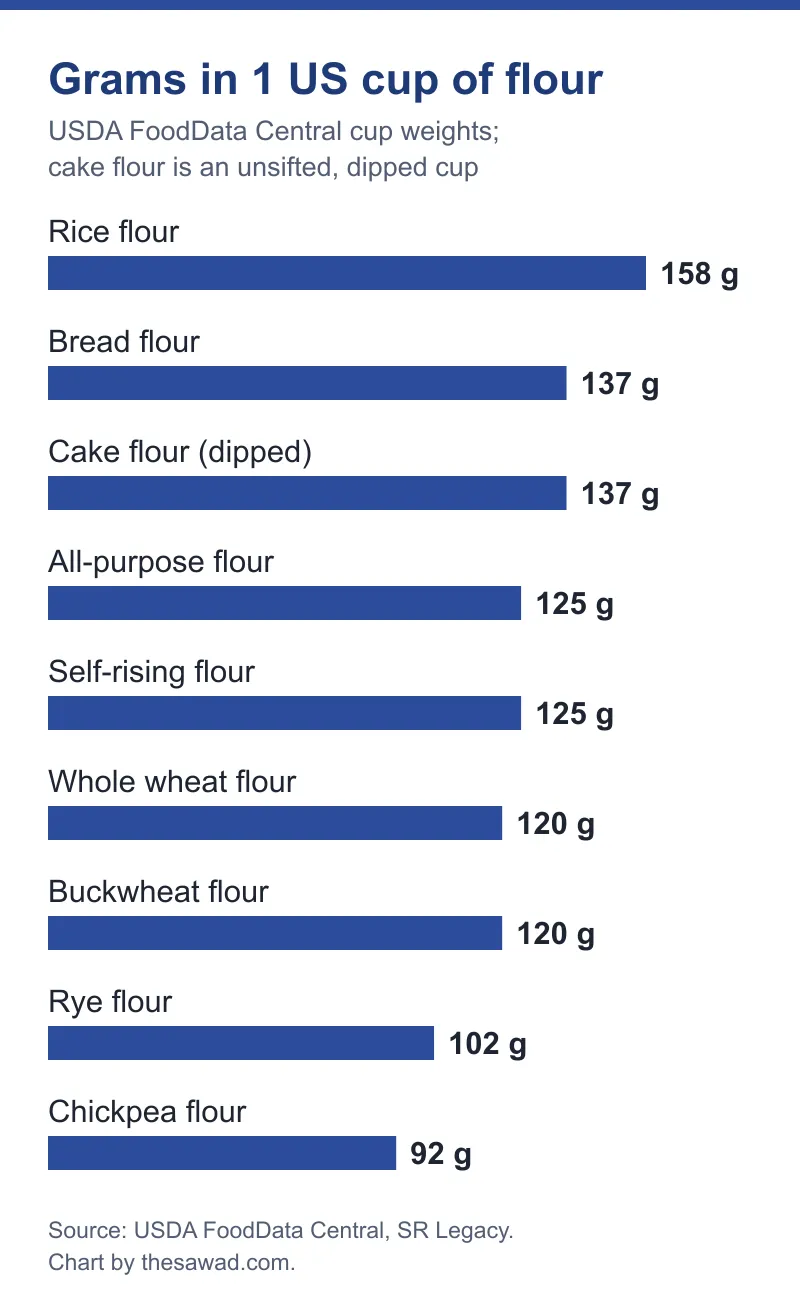
- USDA lists a cup of all-purpose flour at 125 g, bread flour at 137 g and whole wheat flour at 120 g.
- The USDA cake flour figure, 137 g, is for an unsifted, dipped cup, so read the portion label before you convert.
How to measure flour with the spoon and level method
- Use a dry measuring cup, the kind that is full to the rim at its marked size.
- Hold the cup over the flour container or a sheet of wax paper, as Illinois Extension advises, so spills do not land in your bowl.
- Spoon the flour in lightly until it heaps above the rim. Do not press it down.
- Do not shake the cup. Shaking settles the flour, so more fits in.
- Sweep a straight edge, such as the back of a knife, across the rim to level it.
Why scooping gives you too much flour
Pushing the cup into the bag presses the flour together, so more of it fits in the same space. If a spooned cup of all-purpose flour weighs 125 g, the 150 percent that Illinois Extension warns about is 187.5 g. That is 62.5 g extra, or half a cup of flour the recipe did not ask for.
How much does a cup of flour weigh?
It depends on the flour. A cup is a volume, and some flours pack more weight into it than others. These are the USDA FoodData Central weights for 1 US cup. The tablespoon column divides each cup by 16.
| Flour | Grams per cup | Grams per tablespoon |
|---|---|---|
| All-purpose flour | 125 g | 7.8 g |
| All-purpose flour, unbleached | 125 g | 7.8 g |
| Self-rising flour | 125 g | 7.8 g |
| Bread flour | 137 g | 8.6 g |
| Cake flour, unsifted, dipped | 137 g | 8.6 g |
| Whole wheat flour | 120 g | 7.5 g |
| Buckwheat flour | 120 g | 7.5 g |
| Rye flour, medium | 102 g | 6.4 g |
| White rice flour | 158 g | 9.9 g |
| Chickpea flour (besan) | 92 g | 5.8 g |
If your recipe lists flour in grams, the grams to cups converter turns grams into cups for each of these flours and 99 other ingredients.
How to measure less than a cup of flour
Use measuring spoons, spooned and leveled the same way as the cup. A US cup is 16 tablespoons, and a tablespoon is 3 teaspoons. With all-purpose flour at 125 g a cup, these amounts work out as follows.
| All-purpose flour | Cups | Spoons |
|---|---|---|
| 25 g | 0.20 cup | 3 tablespoons plus 1/2 teaspoon |
| 50 g | 0.40 cup | 6 tablespoons plus 1 teaspoon |
| 100 g | 0.80 cup | 12 tablespoons plus 2 1/2 teaspoons |
| 150 g | 1.20 cups | 1 cup plus 3 tablespoons plus 1/2 teaspoon |
| 200 g | 1.60 cups | 1 1/2 cups plus 1 tablespoon plus 2 teaspoons |
The spoon amounts are rounded to the nearest half teaspoon. For more spoon math, see tablespoons in a cup.
Is it better to weigh flour?
Yes, when you have a scale. A scale reads the same 125 g however loosely or tightly the flour sits in the bag, so it removes the packing problem. Without one, the spoon and level method gets you close to the USDA cup weight that recipes and converters use.
Frequently asked questions
How many grams is 1 cup of all-purpose flour?
125 g, the USDA FoodData Central cup weight. Bread flour is 137 g and whole wheat flour 120 g.
How many tablespoons of flour are in a cup?
- Each tablespoon holds about 7.8 g of all-purpose flour, spooned and leveled.
How do I measure 100 g of flour without a scale?
100 g of all-purpose flour is 0.80 cups. Spoon and level 12 tablespoons plus 2 1/2 teaspoons.
Should I sift flour before measuring?
Follow the recipe's wording. In the USDA table only the cake flour entry names a method, unsifted and dipped; the others list a plain cup.
Does bread flour weigh more than all-purpose flour?
Yes. USDA lists bread flour at 137 g a cup and all-purpose flour at 125 g, so a cup of bread flour holds 12 g more.
Can I use a liquid measuring cup for flour?
A liquid cup is hard to level, because the marked line sits below the rim. Use a dry cup that is full at its rim, so you can sweep the top flat.
Conclusion
Spoon the flour in, heap it and level it, and a cup lands close to the USDA weight your recipe expects. When a recipe gives grams, the grams to cups converter does the math for you. For recipes to bake with, see the TheSawad cookbooks.
Sources
- Jenna Smith, Illinois Extension, "Measuring Ingredients for Success", Simply Nutritious, Quick and Delicious blog, 11 November 2015 (read 10 October 2026): spoon the flour into the cup until heaping, do not shake the cup, level it over the container, and scooping can give 150 percent of the right amount.
- USDA FoodData Central, SR Legacy foods, cup portion weights for each flour above, read through the API (read 8 October 2026).